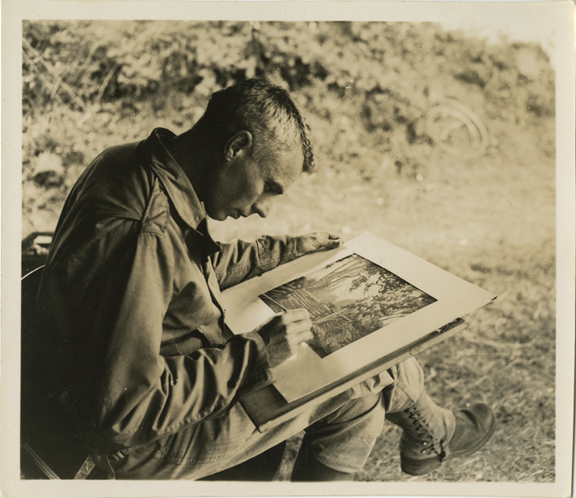
MACMILLAN, HENRY JAY – CAPT USA
Class of 1926Service: U.S. Army
Service Dates: 1942-1946
Rank: Captain
MOS: Combat Artist
Notable: Combat Artist
Born January 13, 1908 graduated from New Hanover High School ~ 1926
Studied architecture and interior design at the New York School of Fine and Applied Arts, Paris Branch further studied at the Colorado Springs Fine Arts Center and Woodstock School.
He was founder and member of the board of directors of the N.C. Professional Artists' Club. One of his paintings was included in the New York World's Fair. His portraits, "Liz" was reproduced in The New York Times. He painted a mural for the Sperry Corp. in the RCA Building. MacMillan designed interior decorations for Thalian Hall in Wilmington.
He served in the U.S. Army as a combat artist in North Africa, Sicily, Normandy, Belgium, Holland and Germany.
It was a tumultuous year for MacMillan, who at age 35 was making a comfortable living as a portrait and landscape artist. That changed abruptly when he was inducted into the U.S. Army.
After infantry training and temporary duty at Fort Bragg, he was transferred to the 62nd Engineer Topographic Company, a mapping outfit operating out of Fort Belvoir, Virginia. Then in 1944, the 62nd was assigned to the First and Ninth U.S. Armies in France and Germany. MacMillan and the 62nd arrived in France just days after the D-Day invasion, June 6, 1944.
A mixture of bravado and terror seemed to animate war artists, and MacMillan was no exception. Never reluctant to put himself in danger, he sought to convey the reality of war through firsthand experience. He explored the visual and sensory dimensions of warfare that are often absent in battle accounts. He was a soldier first but also specifically commissioned to be in the most dangerous areas to observe military activity. He recorded war in ways that cameras could not, collecting experiences from the people who endured and the places that survived.
He found his subjects in perilous areas and created the most painful sequences in his own style to convey the reality of war. He could illustrate the very soul of a battle and describe mournful, battle-weary scenes while at the same time omitting the harrowing side of humanity. His focus was on ordinary soldiers set against the ash-gray ruins of the towns where they fought. Never metaphoric, his art drew the war as realistically as possible — a style evident in his depictions of the devastating hedgerow action in Normandy, France.
The hedgerows of Normandy, which saw furious fighting after D-Day, were MacMillan’s first assignment. His initial works were watercolor landscapes of the hedgerows and nearby towns, several of which show the ruins of once-lovely French villages destroyed by war.
Realism was the constant in MacMillan’s art, which poignantly illustrated the antipathy of combat. His haunting watercolor The Ruins of Palace de Justice at Saint-Lo shows the ruined city with a bomb crater in the foreground surrounded by rubble. His powerful watercolor Roer River Ruins, at Julich, Germany depicts bare trees shredded by artillery with ruined buildings in the background.
A major exhibition of his watercolors and sketches documenting wartime were shown at the Wilmington-NHC Museum and at the Cape Fear Museum The Art of Henry Jay MacMillan – Wrightsville Beach Magazine
Accolades: Combat Artist
Accolades: Combat Artist