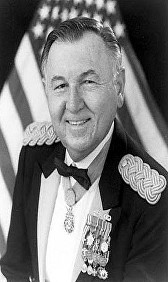
MURRAY, CHARLES “CHUCK” P. Jr. – COLONEL, U.S. ARMY MOH
Class of 1938Service: U.S. Army
Service Dates: 1941-1975
Rank: COLONEL
MOS: Infantry Officer
Notable: MEDAL OF HONOR
Murray attended University of North Carolina and was drafted into the U.S. Army after his third year.
Serving as a replacement platoon leader to Company C of the 30th Infantry Regiment, 3rd Infantry Division in Saint-Tropez, France and later in Germany where he became Company Commander. He received the rank of Colonel with the 1st Battalion, 30th Infantry Regiment. He served with the 3rd U.S. Infantry Regiment (The Old Guard). Murray returned to Wilmington after an injury only to return to Europe and served four years of occupation duty. During this time, he was stationed in Salzburg and became the head U.S. Intelligence officer in that city.
Rank and organization: First Lieutenant, U.S. Army, Company C, 30th Infantry, 3d Infantry Division.
Place and date: Near Kaysersberg, France, 16 December 1944.
Entered service at: Wilmington, New Hanover Co, North Carolina
Birth: 26 September 1921, Baltimore, Maryland
Died: 15 August 2011
Buried: Arlington National Cemetery, Arlington, VA
General Order No. 63, 1 August 1945.
Citation: For commanding Company C, 30th Infantry, displaying supreme courage and heroic initiative near Kaysersberg, France, on 16 December 1944, while leading a reinforced platoon into enemy territory. Descending into a valley beneath hilltop positions held by our troops, he observed a force of 200 Germans pouring deadly mortar, bazooka, machine-gun, and small arms fire into an American battalion occupying the crest of the ridge. The enemy's position in a sunken road, though hidden from the ridge, was open to a flank attack by 1st Lt. Murray's patrol but he hesitated to commit so small a force to battle with the superior and strongly disposed enemy. Crawling out ahead of his troops to a vantage point, he called by radio for artillery fire. His shells bracketed the German force, but when he was about to correct the range his radio went dead. He returned to his patrol, secured grenades and a rifle to launch them and went back to his self-appointed outpost. His first shots disclosed his position; the enemy directed heavy fire against him as he methodically fired his missiles into the narrow defile. Again he returned to his patrol. With an automatic rifle and ammunition, he once more moved to his exposed position. Burst after burst he fired into the enemy, killing 20, wounding many others, and completely disorganizing its ranks, which began to withdraw. He prevented the removal of 3 German mortars by knocking out a truck. By that time a mortar had been brought to his support. 1st Lt. Murray directed fire of this weapon, causing further casualties and confusion in the German ranks. Calling on his patrol to follow, he then moved out toward his original objective, possession of a bridge and construction of a roadblock. He captured 10 Germans in foxholes. An eleventh, while pretending to surrender, threw a grenade which knocked him to the ground, inflicting 8 wounds. Though suffering and bleeding profusely, he refused to return to the rear until he had chosen the spot for the block and had seen his men correctly deployed. By his single-handed attack on an overwhelming force and by his intrepid and heroic fighting, 1st Lt. Murray stopped a counterattack, established an advance position against formidable odds, and provided an inspiring example for the men of his command.
COL Murray served in World War II, Korean War, and the Vietnam War.
Murray Middle School in Wilmington is named in his honor. https://www.cmohs.org/recipients/charles-patrick-chuck-murray-jr
Accolades: Medal of Honor, Silver Star (3), Legion of Merit, Bronze Star with Valor devie (2) and the Purple Heart
Accolades: Medal of Honor, Silver Star (3), Legion of Merit, Bronze Star with Valor devie (2) and the Purple Heart